V-Stack animated logo
Patent-Pending · Active Development · Pre-Seed
verticalstack.energy
Stacking the Future of Energy

≈600 GWh of U.S. Grid Storage.
≈48 Months. Community First.

Patent-pending modular vertical energy towers deploying non-flammable sodium-ion storage on urban footprints — with 40% of profits permanently reserved for host communities.

1.97 GWh per tower
40% Community profits
≈6 months per Tower deployment Post Connections, Permits & Foundations
5% RTD licensing fee
See the Solution Partners Access
The Vision

See What We're Building

The energy crisis facing American computing infrastructure cannot be solved with yesterday's regulatory delays. Here's how we change that.

A ~600 GWh V-Stack network would function as a strategic grid reserve — roughly nine hours of coverage against a 67 GW AI/data-center demand surge, helping absorb volatility while new generation, transmission, and interconnection capacity catch up.

The Crisis

America's grid is breaking under the load

The race for frontier AI is no longer a software sprint — it's a brutal, physical war for megawatts. The current system cannot keep pace, and the bottleneck is costing the nation its technological edge.

Chicago Pillar — VTCNZE night view showing V-Stack tower network
28 GW
Northern Illinois connection backlog Data center requests have swelled to 28 GW — effectively doubling the utility's highest peak demand in its entire 120-year history.
4+ yrs
Standard interconnection queue American technological dominance cannot wait four years for a substation engineering review. The status quo is untenable.
∞ acres
Land hunger of legacy storage Traditional battery yards require hundreds of flat acres, local zoning fights, and sprawling horizontal footprints that cities can't provide.
Market Validation

GWh storage is now infrastructure.

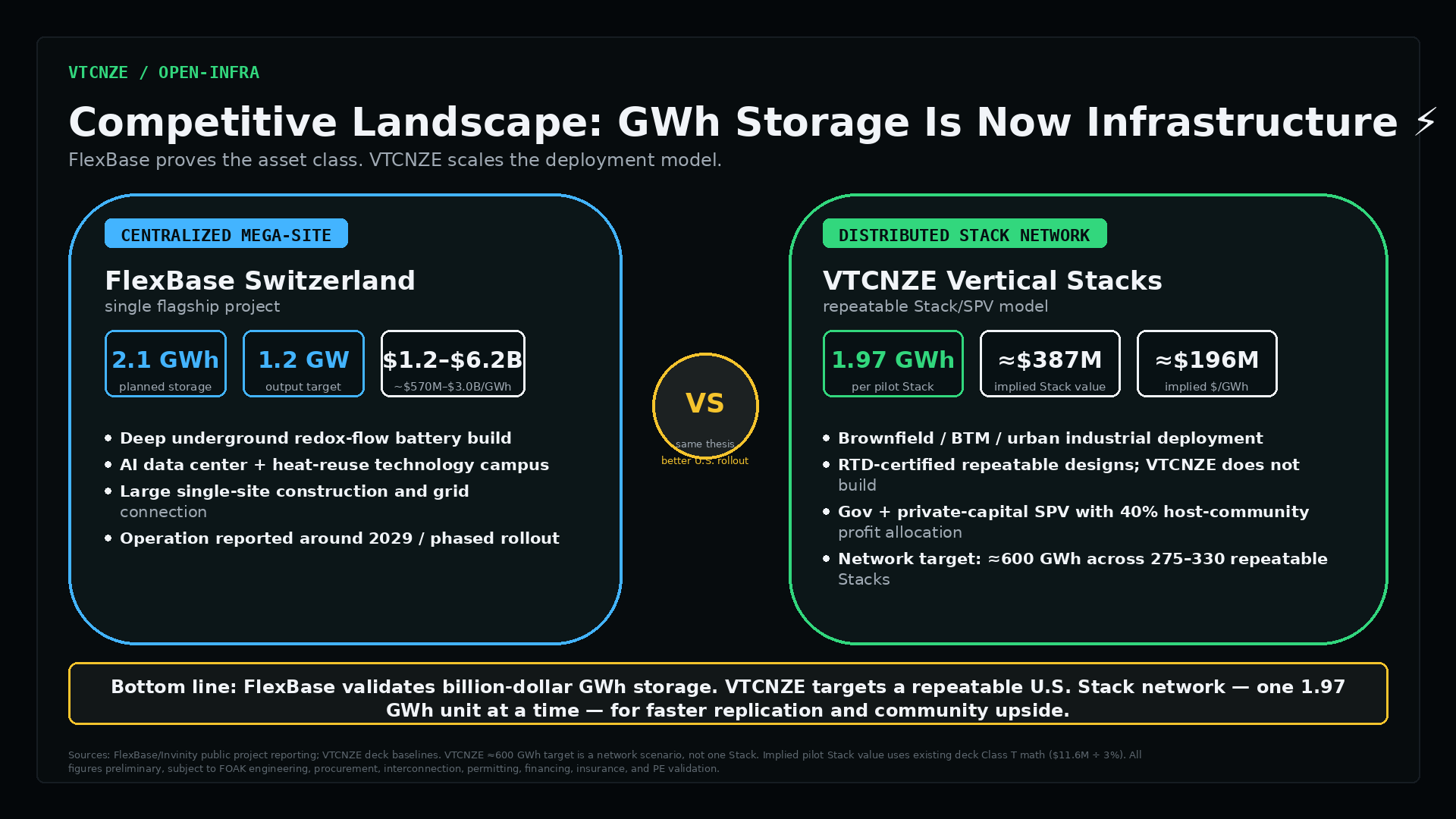
FlexBase proves the asset class. VTCNZE scales the deployment model — shifting the thesis from one centralized mega-site to a distributed Stack network designed for faster U.S. replication, brownfield / BTM deployment, and community-aligned upside.

Competitive landscape comparing FlexBase Switzerland with VTCNZE Vertical Stacks

Efficiency in a glance: comparison uses publicly reported FlexBase figures and VTCNZE deck baselines. All VTCNZE figures are preliminary and subject to FOAK engineering, procurement, interconnection, permitting, financing, insurance, and independent PE validation.

The Solution

Flip the physics.
Go vertical. BTM / FTM Ready.

V-Stack converts land-constrained urban and brownfield sites into dispatchable, modular GWh-scale energy assets. By stacking self-contained, engineer-reviewed modules vertically, we bypass the spatial trap entirely.

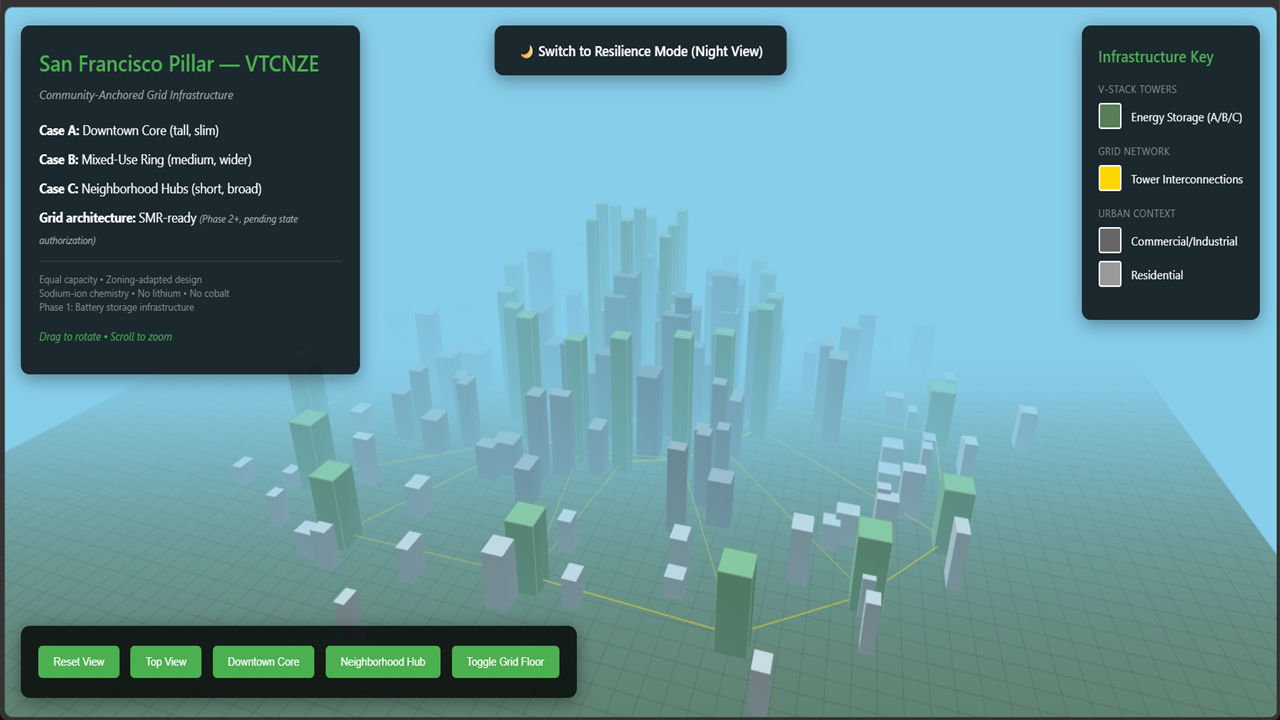
V-Stack Chicago Pillar day view — community-anchored grid infrastructure
Vertical Density

Urban footprint, GWh-scale output. A 30-story V-Stack delivers 1.97 GWh on a fraction of the land a conventional battery yard requires.

🔋
Non-Flammable Chemistry

Sodium-ion baseline architecture — no lithium, no cobalt, no thermal runaway. Thermally stable chemistry designed for zero-occupancy industrial classification.

🏗️
Modular Speed-to-Power

Factory-assembled energy modules trucked in and slotted into a structural column skeleton. Customized patent-pending methods enable 1+ stories per day post permits and foundations.

🔗
Grid-Ready Architecture

Designed for grid support, power continuity, resilience, and black-start functions. Pairs with renewables, behind-the-meter loads, data centers, and future clean generation.

Product Family

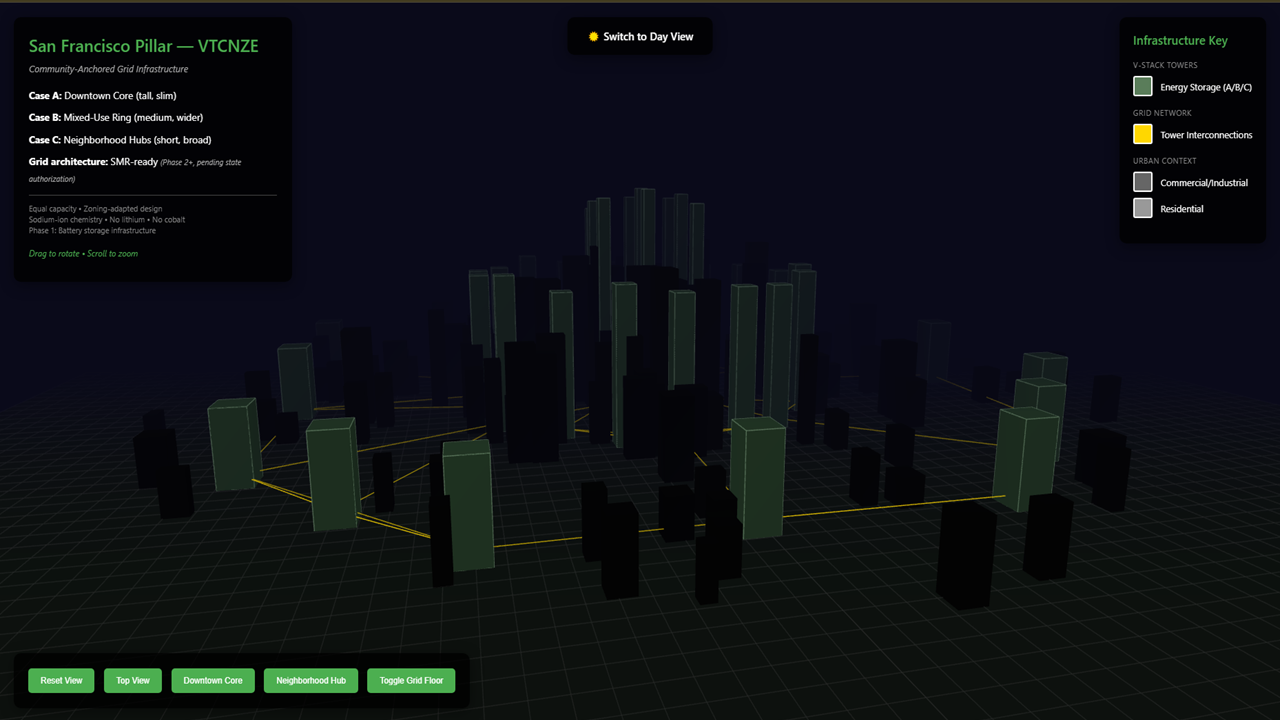
The V-Stack VTCNZE Class Matrix

Four building configurations engineered for different urban contexts and deployment scales — all running the same certified Registry of Trusted Designs (RTD) platform.

Class A
Downtown Core
High Rise
Tall · Slim Profile
  • Maximum floors, minimum footprint
  • Dense urban / CBD sites
  • Premium grid placement
Class B
Mixed-Use Ring
Mid Rise
Medium · Wider Profile
  • Mixed-use urban zones
  • Transit-adjacent sites
  • Flexible floor layouts
Class D
Neighborhood Hub
20-Floor
Compact · Emerging Economy
  • Smaller urban footprints
  • Emerging economy deployments
  • Community-scale resilience
Platform Longevity

100+ Year Upgrade Path

V-Stacks are designed as long-life infrastructure chassis with replaceable energy modules, modular energy-floor additions, RTD-certified upgrades, evolving storage chemistries, and software-driven grid optimization across a 100+ year asset horizon.

Business Model

We are franchisors.
We license. Others build.

VTCNZE operates the Registry of Trusted Designs (RTD) — the IP and certification platform that every V-Stack deployment licenses. We design; partners build. This is the most capital-efficient infrastructure model in the sector.

1
RTD License Issued

A licensed operator or SPV receives access to the Registry of Trusted Designs — our patent-pending blueprint, chemistry specs, structural system, and operational protocols.

2
SPV Formed with Gov Partners (PROPOSED ONLY)

Each stack is built inside a Sovereign SPV with PROPOSED Federal (15%), State (15%), Municipal (10%), and private capital (57%) equity classes — de-risked by authority partners handling permitting heavy lifting.

3
Tower Deployed & Operational

The modular construction system enables rapid builds. Once operational, the tower generates grid revenues from energy storage, ancillary services, and demand response.

4
5% Gross Revenue to VTCNZE

VTCNZE collects a 5% gross licensing fee from every stack in perpetuity. The RTD network scales with every deployment — recurring, asset-backed, non-dilutive revenue.

Revenue Model — Per Stack / Per Year
Stack gross revenue $52M – $77M
VTCNZE 5% RTD fee $2.6M – $3.85M
Illustrative network 275–330 Stacks
11 major metro corridors ≈ 600 GWh total
Network annual recurring $715M – $1.27B+
Class T book value / stack $11.6M
Community Ownership

From NIMBY
to WIMBY

Welcome In My Backyard. Infrastructure builders can no longer operate in isolation from the neighborhoods hosting them. We didn't build a token gesture toward community benefit — we engineered it into the legal structure of every deployment.

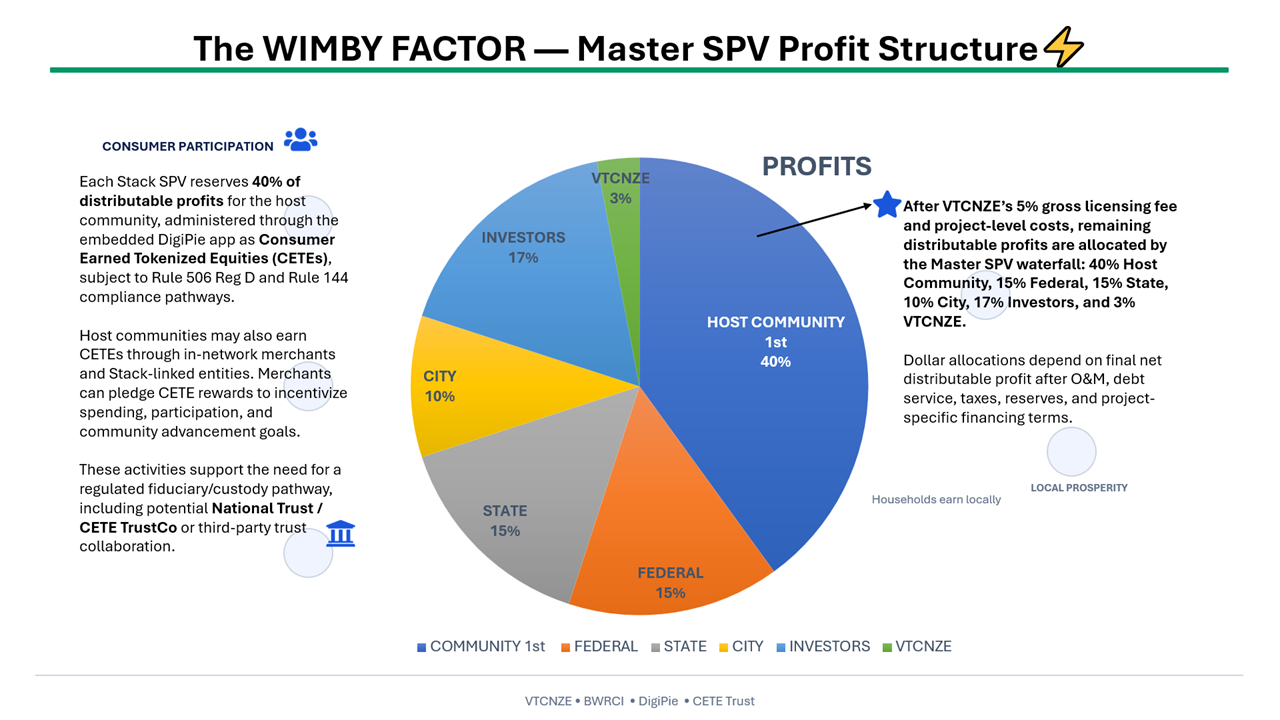
WIMBY FACTOR — Master SPV Profit Structure showing 40% host community allocation

40% of profits.
Permanently.
By contract.

Each Stack SPV permanently reserves 40% of distributable profits for the host community — administered through the embedded DigiPie app as Consumer Earned Tokenized Equities (CETEs). This isn't goodwill. It's a contractual waterfall baked into every RTD license.

When behind-the-meter assets contractually preserve localized economic distribution layers — allowing local spenders and merchants to participate in the asset's performance — the narrative shifts entirely. A localized power burden becomes a generational wealth engine. (CITY/STATE & FEDERAL= PROPOSALS ONLY)

SPV Profit Waterfall (Proposed)
40% Host Community 15% Federal 15% State 10% City 17% Investors 3% VTCNZE

Subject to Rule 506 Reg D and Rule 144 SEC compliance pathways. Dollar allocations depend on final net distributable profit after O&M, debt service, taxes, and reserves.

National Deployment

Chicago Validates.
America Scales.

The first 1.97 GWh baseline V-Stack establishes the engineering precedent, regulatory pathway, and financial template. The RTD certifies the standard. The network replicates the model — 25 to 30 stacks per major metro corridor, across 11 U.S. deployment corridors.

1.97 GWh Baseline Stack Unit
25–30 Stacks per Metro Corridor
11 Major Metro Corridors
≈600 GWh Total Nameplate Capacity
Illustrative U.S. Deployment Corridors · Chicago = Primary Validator · RTD Certified Standard
Illustrative RTD Network Revenue Potential
$715M–$1.27B+
5% RTD license fee across illustrative U.S. network
1.97 GWh
Baseline Stack Unit
Class C-H · Chicago Pilot
25–30
Stack Replication Target
per major metro corridor
11
Major Deployment
Corridors
275–330
Illustrative U.S.
Stack Network
≈600 GWh  ·  ≈250 GW
Total Nameplate Capacity · Dispatchable Power Equivalent
Scale Math
25–30 stacks × 11 metros = 275–330 stacks ≈ 600 GWh
New York Boston Detroit Atlanta Miami Houston Dallas Denver Seattle San Francisco Los Angeles CHICAGO PRIMARY VALIDATOR
Chicago Pilot
V-Stack Corridor Node
RTD Network Link

Chicago is the validator. The RTD certifies the standard. The network scales the model. The first Class C-H pilot establishes the engineering precedent, regulatory pathway, and financial template that every subsequent stack inherits. This is infrastructure — and infrastructure compounds.

Illustrative deployment scenario. Subject to site control, permitting, engineering validation, interconnection, financing, and market conditions. Not an offer or solicitation of securities.

Policy Framework

An Executive Blueprint for America's Grid

We don't just build — we've drafted the policy architecture that unlocks 600 GWh in 48 months. The framework targets DOE, FERC, and federal land agencies to bypass the legacy utility backlog.

180-Day Fast-Track

RTOs and balancing authorities directed to complete engineering reviews and grant Permission to Operate for qualifying load-adjacent storage assets within 180 days — bypassing standard wholesale generation queues.

🏭

Brownfield Prioritization

Federal and industrial brownfield sites adjacent to major urban digital infrastructure corridors fast-tracked for competitive long-term leasing. V-Stack's vertical architecture is purpose-designed for these footprints.

🛡️

Ratepayer Protection

No qualifying AI infrastructure deployment shall pass infrastructure upgrade costs onto residential ratepayers. Federal preference given to projects utilizing structured SPVs that share economic upside with host municipalities.

🔬

Domestic Chemistry Priority

Projects utilizing thermally stable sodium-ion baseline architectures receive priority access to DOE Title XVII Loan Guarantee Program and FAST-41 National Priority Energy Project designation.

🏙️

72-Hour Permit Shot-Clock

Municipal Class M equity participation in the SPV structure provides land easements and a 72-hour ministerial permit shot-clock — eliminating the local bureaucratic lag that kills conventional projects.

🌐

Open-Infra Architecture

The RTD operates as an open-core infrastructure standard — enabling broad adoption while the patent-pending systems and methods remain protected. Standards proliferate; IP compounds.

The foregoing policy blueprint is presented for conceptual and educational purposes to illustrate macro-energy deployment pathways. It does not constitute formal legal or political solicitation. The SPV equity configurations and localized reward loops represent proprietary operational frameworks utilized in advanced infrastructure design.

Modular Construction

Built like manufacturing,
not construction

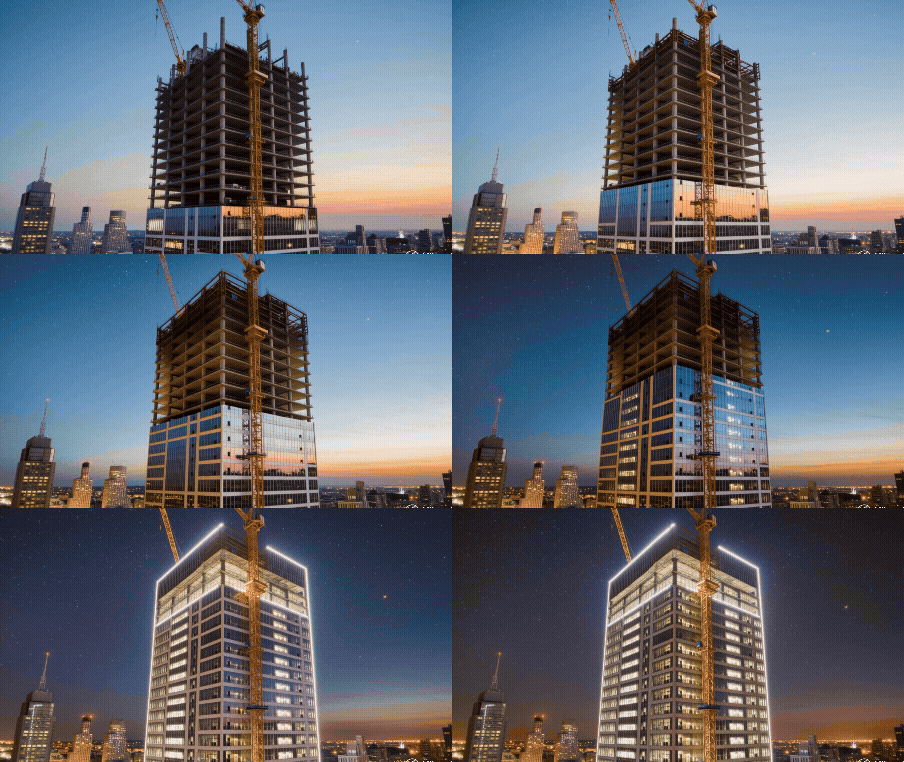
Our modular building system is engineered to build at unprecedented speed. Customized patent-pending assembly methods enable erections of 1+ stories per day post permits and foundations — transforming a ground-breaking into a GWh-scale operational asset faster than any conventional method.

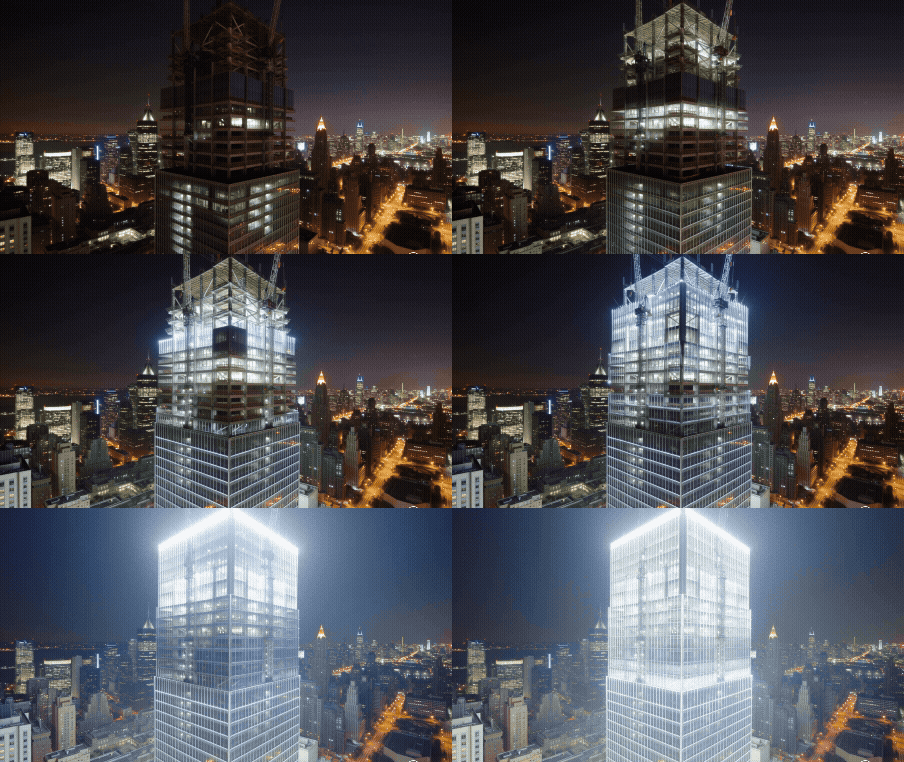
V-Stack VTCNZE Building modular construction timelapse
VTCNZE Building Specs
Build rate 1+ stories/day
Structure type Modular vertical column
Assembly method Rapid assembly by others
Occupancy classification Zero-occupancy industrial
Pilot height 30 stories
Chemistry Sodium-ion (non-flammable)
Pilot capacity 1.97 GWh
IP status Patents pending

The factory-assembled energy blocks are trucked in and slotted into a structural column skeleton simultaneously as site prep occurs — parallel manufacturing, not sequential construction.

Capital & Community Pathways

Join the coalition

Two pathways to participate in the infrastructure opportunity of this decade — structured to include everyone, from institutional capital to community investors.

Accredited Investors

Master SPV — Private Capital Tranche

Accredited Capital Partners Master SPV — Private Capital Tranche VTCNZE is evaluating a Master SPV structure that may include a Class P tranche for institutional and accredited capital partners. The proposed model is designed to align private capital with potential Federal, State, and Municipal participation, where available, to support site coordination, permitting pathways, and public-benefit infrastructure deployment. Securities-related participation, if pursued, would be conducted only through appropriate offering documents and applicable exemptions, including Rule 506 of Regulation D where applicable.

Request Coalition Package
Community Investors

Reg CF — Public Participation

Community members may invest through a compliant Reg CF offering where applicable. Separately, DigiPie, the embedded app, may support community rewards, merchant engagement, and post-deployment local value flows tied to host-community participation.

Join the Waitlist
Pre-Seed Capital Allocation
$1.25M
FOAK Engineering + PE Validation
$900K
Legal, IP + SPV Architecture
$1.1M
Executive Team Build-Out
$850K
FOAK Site + Commercial Dev
$500K
DigiPie / CETE Integration
$400K
Fundraising + Coalition Materials
Connect

Ready to stack
the future?

Whether you're an investor, policy maker, site operator, municipality, or community stakeholder — there's a place for you in the V-Stack coalition. Tell us who you are.

By submitting, you acknowledge this is a pre-commercial discussion. All information is confidential. Investment offerings are subject to SEC compliance and accreditation requirements.

✓ Message received. We'll be in touch shortly.